Rocket Launch

Did you see the launch of the SpaceX Falcon Heavy rocket today? It’s rare to see such a powerful glimpse of technology and the future while the Sun is in Aquarius. The sign of Aquarius actually rules invention, outer space, genius, science, humanity and the future.

The Falcon is the most powerful rocket in history – equivalent to eighteen 747 airplanes. This picture, however, is the boosters of the rocket landing THEMSELVES perfectly on the landing pad!! I’ve never seen that before and it is amazing footage.

spacex-falcon-heavy-tandem-landing

The launch was thrilling to see, but it was more astonishing to see the boosters come back to Earth and land themselves. So glad Spacex and Elon Musk are pursuing space explorations. Check out this footage:

Here’s an article in The NY Times about it today.

Full Moon Eclipse in Leo

752190e822d6661513c043d8447febaf

Full Moon in Leo: Wed. January 31st at 5:27am Pacific.

Since this is also an eclipse, and eclipse’s give us a glimpse of the future, watch for sign posts the next few days that show you where you are headed.

Something will “ripen” or come to fruition that started in August last year. A seed was planted in a corner of your life, and has been growing in silence the last several months. It is about to come to full bloom, and will usher in a new direction for each of us.

Leo has to do with being visible, leadership, shining your gifts and talents, setting an example for others, inspiring people, standing out from the crowd, specialization, childlike wonder, healing and opportunities. It’s the only zodiac sign actually ruled by the Sun, and the Sun is the largest light in our solar system. It’s the star that we revolve around, and without it there is no life.

So what are your gifts? What were you put here to do and where are you in the process of expressing it fully? Are you shining your light and being visible? Expressing yourself in the service of others is the lesson of Leo and Aquarius. If you’re struggling or experiencing emotional pain, the best thing to do is help someone else out. You will feel better, I promise!

Here’s how this eclipse will effect each of us. Go here to figure out your rising sign, or contact me for a reading!


Aries Rising: The Full Moon lights up your House of Creativity and Children. What do you want to leave behind someday? What’s your contribution to the world? If you’re an artist, or creative person, expect a breakthrough this week in how you express yourself – that can also mean children.

Taurus Rising: Eclipse in your psyche and home. The 4th House rules your living situation, your Mom, and your deepest psychological roots. Something in one of these areas has been “growing” in you since August 2017; expect illumination or breakthrough in this area that will point to your future.

Gemini Rising: Illumination in how you communicate and share the stuff you know. Do you mentor others? Validate your experience and knowledge and write something for the public that leads to greater understanding. Siblings could be a theme as well.

Cancer Rising: The Full Moon shines on your values and money! A breakthrough will occur with regards to what is most important to you. There’s a new clarity with security and resources. Something comes to fruition involving income, material stability and what you value.

Leo Rising: This eclipse shines directly on YOU and how you approach your world. It shows the way forward and illuminates the best ways to focus your energy – between now and August 2018. This Full Moon wants you to ask yourself – who are you right now? Take stock of your life and how you want to proceed.

Virgo Rising: Some new clarity is here that helps you connect with your personal psychology, how you self sabotage and your path to spirituality. It’s a breakthrough in self awareness. This week is a time of soul searching and communing with the god of your heart.

Libra Rising: It’s a wonderful week that gives progress in monetary gains, your social circle and where you belong. There will be breakthroughs with regards to groups and friends, plus you will see some results from where you’ve been focusing your energy the last few months.

Scorpio Rising: Breakthrough about your career, your place in the world, and the role you want to be known for. Responsibilities and commitments could be a theme as well. You’re at a crossroads.

Sagittarius Rising: Breakthrough about what you believe in, the philosophy or ethics that guide your life, and even your education. Publishing, legal matters, foreign travel, and long distance journeys could be a theme as well.

Capricorn Rising: A breakthrough regarding Other People’s Money and/or Sex. This can mean credit, real estate or investment. Do your taxes this week! Wealth, debt, benefits, and estate planning – all the stuff Capricorns love. Partnership or sex issues may also be highlighted.

Aquarius Rising: A breakthrough regarding a relationship, partnership, or connection. Similarly, a partner or mate may have a major event in his or her life. You’re at a crossroads.

Pisces Rising: There’s a breakthrough about your everyday life, your habits and how you make money day to day. from how you schedule your daily to the work you do and the projects you’re involved in. Health, wellness, duties, and even your colleagues could be themes as well.

Uranus is our capacity to experience “The Revolution,” freedom to do things our own way, exhibiting our individual expression or even “Going Rogue” as we blast towards a future collective vision. Uranus inspires individual inclination to “Let me be ME” and connect to an ocean of humanity doing the same.
MoonCat! © Mother Tongue Ink 2011
from We’Moon 2017: Stardust Appendix pgs
Weekly Starcodes
excerpt by Heather Roan Robbins—Visit our Astology Connection page for the complete daily predictions for the week and an overview of the Year for the current SunSign.
In 2018 we need to garden our perception and intuition like they’re our last hope for food. The most prominent aspect the year ahead is a trine between expansive Jupiter and intuitive Neptune (exact 5/26, 8/19, felt through September). Neptune stimulates the realm where our imagination, delusion, our hopes and fears, insight and lies, spirituality and intuition magnify and mingle, but it does not help us differentiate between them. To safely develop our intuition, we need to learn the difference between our desires or anxieties, and our true perceptions. We’ll need all our senses to guide us this year so that we can vision a better future and make it so, instead of feeling swamped with Neptune’s shadow of lighting or the illusion of wishful thinking.
 
Listen to the deeper call underneath the proliferating illusions of hopes and fear, beneath a Neptunian longing to escape, to feel what is real, to feel our interconnection, and then act decisively and pragmatically to benefit all our relations. 
 
Water is life. Neptune refers pragmatically to water, and water rights will stay problematic, a symbol for that pool of intuition in which swim. Tend to the waters; water rights, water quality, and we symbolically tend to the health of both the earth, and of our spirit. 
 
We will need to fill the wells of our spirit this year, or we can crave escape from a grim ordinary reality as Saturn in Capricorn approaches Pluto (conjunct in 2019) and old patriarchal authority structures flex their muscles. Between now and 2024, Pluto traverses the path it took right before the American Revolution, . . . 
 
. . . Let’s use this Capricorn lineup to organize, strengthen, and structure our work. 
 
Uranus enters earthy Taurus on May 15, . . . Uranus will catalyze change to our approach to material resources over the next eight years, but may do so by creating a real challenge first. The trick will be not to waste energy in petty power dynamics with one another, but instead keep our eye on the prize and scale one mountain at a time .. . .

Miyazaki’s Shinto spirits

totoro02

Excellent article on one of my favorite filmmakers.

The Gods and Spirits (and Totoros) of Miyazaki’s Fantasy Worlds

“There’s a moment in Hayao Miyazaki’s film My Neighbor Totoro that’s stuck with me since I first watched it a decade ago. Satsuki Kusakabe is searching for her missing sister, Mei. Looking for help, she sprints towards the huge camphor tree where the magical creature Totoro lives. She pauses for a moment at the entrance to a Shinto shrine that houses Totoro’s tree, as if considering praying there for Totoro’s help. But then she runs back to her house and finds her way to Totoro’s abode through the tunnel of bushes where Mei first encountered him. Totoro summons the Catbus, which whisks Satsuki away to where Mei is sitting, beside a lonely country road lined with small statues of Jizo, the patron bodhisattva of children.

It’s Satsuki’s hesitation in front of the shrine’s entrance that sticks with me, and what it says about the nature of spirits and religion in the film. We don’t really think of the movies of Hayao Miyazaki as religious or even spiritual, despite their abundant magic, but some of his most famous works are full of Shinto and Buddhist iconography—like those Jizo statues, or the sacred Shimenawa ropes shown tied around Totoro’s tree and marking off the river god’s bath in Spirited Away. Miyazaki is no evangelist: the gods and spirits in his movies don’t follow or abide by the rituals of religion. But the relationship between humans and gods remains paramount.”

Miyazaki’s gods and spirits aren’t explicitly based on any recognizable Japanese “kami” (a word that designates a range of supernatural beings, from the sun goddess Amaterasu to the minor spirits of sacred rocks and trees). In fact, whether Totoro is a Shinto spirit or not is a mystery. He lives in a sacred tree on the grounds of a Shinto shrine. The girls’ father even takes them there to thank Totoro for watching over Mei early in the film. But Satsuki calls Totoro an “obake,” a word usually translated as “ghost” or “monster.” Miyazaki himself has insisted that Totoro is a woodland creature who eats acorns. Is he a Shinto spirit? A monster? An animal? A figment of the girls’ imaginations? The film—delightfully—not only doesn’t answer the question, it doesn’t particularly care to even ask it.”

totoro01


“… Miyazaki’s films don’t invite us to any particular faith or even belief in the supernatural, but they do invite us to see the unexpected, and to respect the spirits of trees and woods, rivers and seas. Like Totoro and Gran Mamare, their true nature and reasoning are beyond our comprehension. Call them kami, or gods, or spirits, or woodland creatures, or Mother Nature, or the environment. They are there if we know where to look, and their gifts for us are ready if we know how to ask. We have only to approach them as a child would—like Satsuki, Mei, Chihiro, and Sosuke—with open eyes and open hearts.”

Occasional fasting slows aging

b8a2b65d20eb3e014e891963e58da2d9
“Fasting is the greatest remedy — the physician within.”

~Paracelsus.

Apparently, intermittent fasting is one of the best things you can do for your body and mind. One of the more popular versions is to simply not eat from 7:00pm every night to 11:00am the following morning. I’ve tried it because I’m always looking for new ways to better my health and resolve. For me, it’s hard to sleep when I’m hungry, so I’m still working it out.

I’m not surprised by the studies saying fasting is good for you. I mean we’re all monkeys. If we were in the wild we wouldn’t be eating fettucine alfredo all day, as much as I would like to!

When you fast, even briefly, it switches on all kinds of positive changes in your body.  It raises your metabolism, increases human growth hormone, lowers insulin, clears the mind and reduces inflammation.


In pursuit of healthy aging

“Although previous work has shown how intermittent fasting can slow aging, we are only beginning to understand the underlying biology,” said William Mair, associate professor at Harvard Chan School.

By Karen Feldscher
Harvard Chan School Communications
November 3, 2017

“Manipulating mitochondrial networks inside cells — either by dietary restriction or by genetic manipulation that mimics it — may increase lifespan and promote health, according to new research from Harvard T.H. Chan School of Public Health.
The study, published Oct. 26 online in Cell Metabolism, sheds light on the basic biology involved in cells’ declining ability to process energy over time, which leads to aging and age-related disease, and how interventions such as periods of fasting might promote healthy aging.
Mitochondria — the energy-producing structures in cells — exist in networks that dynamically change shape according to energy demand. Their capacity to do so declines with age, but the impact this has on metabolism and cellular function was previously unclear. In this study, the researchers showed a causal link between dynamic changes in the shapes of mitochondrial networks and longevity.

This site has a lot of good information if you want to try it. Let me know your experiences and thought’s in the comments below ❤


Saturn in Capricorn

cap1New Moon in Capricorn: 6:17pm Pacific on Tuesday, January 16th, 2018.

This is one of the most productive weeks of the last few years. Anyone feeling super focused, efficient and less tolerant of immaturity since December? That’s when Saturn returned home to the craggy mountainsides of Capricorn. It hasn’t been home in 30 years. What was going on in your life 30 years ago?

The skies are heavily weighted towards Capricorn these days. There are FIVE planets picking their way through Capricorn right now – six if you count Lilith and I ALWAYS count Lilith <3.

But the main event happens this Tuesday with the New Moon in Capricorn. We will experience a rebirth in our determination, ambition and grit – so decide which direction you want to point yourself 🙂

You are likely to feel highly productive, serious and functional. At the same time feeling intolerant of things you used to put up with – like bad relationship dynamics and situations where your contribution and authority were dismissed. Your denial of facts and reality has been blown away and you take yourself more seriously nowadays… down to your bones. The structure of your life will go through a giant overhaul in the next couple of years, and it will be for the better.

Origins of Magicians

old guy

Well here’s a fascinating article by Robert Sepehr.

Article

“The Medes were people of Indo-Iranian (Aryan) origin who inhabited the western and north-western portions of present-day Iran. By the 6th century BC (prior to the Persian invasion) the Medes has established an empire that stretched from Aran (the modern-day Republic of Azerbaijan) to Central Asia and Afghanistan. Today’s population of the western part of the Iranian Plateau (including many Persian-speakers, Kurds and Azeris) consider themselves their descendants.

Apart from a few personal names, the original Aryan language of the Medes is almost entirely unknown, but it was most likely similar to the Avesta and Scythian languages (photo-Indo-European/Iranian). Herodotus mentions that” “The Medes had exactly the same equipment as the Persians; and indeed the dress common to both is not so much Persian as Median”.

Eventually, the older tribes of Aryan Iran lost their district character and amalgamated into one people, the Iranians. In Arabic texts, as in the Greco-Roman tradition, Zoroaster is the “founder” of the Magicians, Arabic ‘Majusya’. There are many views on the timeline for Zoroaster’s life. The traditional Zoroastrian date for Zarathustra’s birth and ministry is around 600 BC Green sources placed him as early as 6000 BC. Zoroaster spoke of duality and ceasing balance at the end of time; his goal, was to show humans their connection to one source of light and consciousness. According to the Zend Avesta, the sacred book of Zoroastrianism, Zoroaster was born in Azerbaijan, in northern Persia.

A Magus was a Zoroastrian astrologer-priest from ancient Persia, and was also referred to as a sorcerer or wizard. The terms magic and magician derive from the word “magus”. The English term may also refer to a shaman. The Greek word is attested from the 5th century B.C., as a direct loan from the Old Persian “magus”.

Professor of Chinese at the University of Pennsylvania, Victor H. Mair, provides archaeological and linguistic evidence suggesting that the Chinese “wu” (shaman; witch, wizard; magician) was also loanword from Old Persian magus “magician; magi”:

The recent discovery at an early Chou site of two figurines with unmistakably Caucasoid or Europoid features is startling prima facie evidence of East- West interaction during the first half of the first millennium Before Current Era. It is especially investing that one of the figurines bears on the top of his head the clearly incised graph (cross with potents) which identifies him as a “wu” (shaman; witch, wizard; magician).

The Aryan, or Indo-European, root appears to have expressed power or ability. This meaning continued, e.g. in Greek “mekhos” (see mechanics) and in Germanic magan (English may), magts (English might, the expression “might and magic”). The original significance of the name for Median priests, thus, seems to have been “the powerful”. The modern Persian “Mobed” derived from an Old Persian compound magu-pati “lord priest”.

The plural “Magi” entered the English language ca. 1200, referring to the Magi mentioned in Matthew 2:1. The singular following only considerably later, in late 14th century, when it was borrowed from Old French in the meaning magician together with magic.

In Farsi, Magi is ‘meguceen’, which meaning “Fire Worshipper”, and it is the origin of the word “magician”. While, in Herodotus, “Magos” refers to either an ethnically Aryan member of one of the tribes/peoples (ethnous) of the Medes, or to one of the Persian priest  who could interpret dreams, it could also be used for any enchanter wizard.

In Hellenism, “Magos” started to be used as an adjective, meaning “magical”, as in magas techne “ars magica” (e.g. used by Philostratus). Sources from before the Hellenistic period include Xenophon, who had first-hand experience  at the Persian Achaemenid court. In his early 4th century BC Cyropaedia, Xenophon depicts the Magicians as authorities for all religious matters, and imagines the Magicians were responsible for the education of the emperor-to-be.

According to to Robert Charles Zaehner, author of the book, The Dawn and Twilight of Zoroastrianism:

We hear the Magi not only in Persia, Parthia, Bactria, Chorasmia, Aria, Media, and among the Sakas, but also in non-Iranian lands like Samaria and Egypt. Their influence was also widespread throughout Asia Minor. It is, therefore, quite likely that the sacerdotal caste of the Magi was distinct from the Median tribe of the same name.”

Extracts from the book Occult Secrets of Vril (chapter 7: Magicians)

About the author:

Robert Sepehr is an author, producer and anthropologist living in Los Angeles, CA.

He specializes in linguistics, paleogenetics and archeology.

Also read:

Rare Aspects

The Path, by Reginald W. Machell

“The Path” by Reginald W. Machell


There’s a rare and powerful aspect happening tonight that will impact the week ahead. The Sun, Venus and Pluto arrive at the same degree of 19 Capricorn. This could be a cathartic event for each of us, depending on where the conjunction falls in your natal chart and the aspects it makes with other planets.

The Sun is your soul’s signature and vision in this lifetime, and brings huge focus and importance to where it falls in your chart AND to where it transits. It’s the giant star that our solar system depends on – the greatest light of all. In conjunction with Venus, it stirs the passions of love and art. Although Venus isn’t completely “happy” in the sign of the goat, the Sun’s presence brings warmth, healing and abundance to relationships or careers that have become stale or stuck. Venus is love and money, and the Sun is fire and healing. ❤

But across the solar system, far out in the hinterlands, sits Pluto. Despite being millions of light years away, it lines up perfectly with the Sun and Venus creating a huge conjunction across our personal star path. Pluto is a dark planet (yes it’s a planet dammit), and symbolizes deep transformation, catharsis, toxic emotions, unhealthy patterns and buried treasure. Pluto (with Venus) brings up our deepest, hidden blocks so we can sacrifice them in the fire of the Sun. We dig through the disappointments of last year and clear them, so we can unearth the real gold buried deep within. What a wonderful to start the year and set the energy of 2018.

From Austin Coppock:

“The other significant configuration which occurs during this span of days is the conjunction of Mars and Jupiter in Scorpio. This is a fierce and triumphant conjunction, the proper mindset of conquerors and the seed of great victories. It brings optimism and relentlessness, and while it shines you will have the capacity to envision victories you are normally too modest to dream.

Take the regalia of the conqueror from Mars and Jupiter, and the clarified passion of the Venus-Sun conjunction, for they are exactly what you need to build the year before you. Do not rush to commit to half-ass, guilty resolutions. Clarify your passion and stoke your courage, for they are exactly what you will need to build the year you desire.
Give the skies time to offer you these boons. Spend the days of this decan receiving these empowerments and constructing your blueprint. Do not start building before the design is complete- give yourself at least until the New Moon later in the month to break ground. 2018 will not be kind to hastily laid plans. It will test even good ones, but has rewards of satisfaction and accomplishment waiting for those who can bring together passion, courage and patience.”

Three Kings

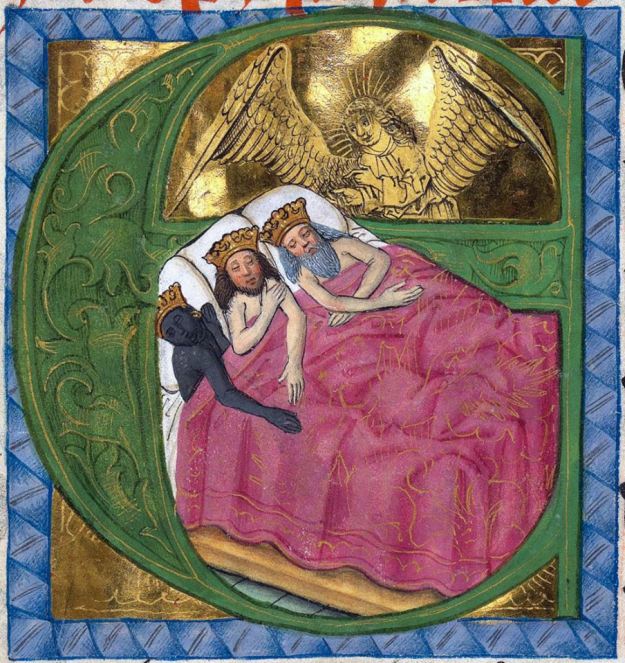
3kings

dream of the three kings ‘Salzburg Missal’, Regensburg ca. 1478-1489 (München, Bayerische Staatsbibliothek, Clm 15708 I, fol. 63r)


Article from Rudolph Steiner:

The Festivals and Their Meaning:
I
Christmas

Schmidt Number: S-0994

On-line since: 23rd December, 1999

VI

On The Three Magi

(Extract from a lecture)

Berlin, 30th December, 1904

You will remember that I have spoken of the meaning of the Christmas Festival in its connection with the evolution of races, or, better said, the epochs of civilisation, and indeed the significance of the Festival lies in this very connection both in respect of the past and of the future.

I want to speak to-day about a Festival to which in modern times less importance is attached than to the Christmas Festival itself, namely, the Festival of the Three Kings, of the Magi who came from the East to greet the newly born Jesus. This Festival of the Epiphany (celebrated on the 6th of January) will assume greater and greater significance when its symbolism is understood.

It will be obvious to you that very profound symbolism is contained in the Festival of the Three Magi from the East. Until the 15th century, this symbolism was kept very secret and no definite indications were available. But since that century some light has been thrown on the Festival of the Magi by exoteric presentations. One of the Three Kings — Caspar — is portrayed as a Moor, an inhabitant of Africa; one as a white man, a European — Melchior; and one — Balthasar — as an Asiatic; the colour of his skin is that of an inhabitant of India. They bring Myrrh, Gold and Frankincense as offerings to the Child Jesus in Bethlehem.

These three offerings are full of meaning and in keeping with the whole symbolism of the Festival celebrated on the 6th of January. Exoterically, the date itself throws some light; esoterically, the Festival is pregnant with meaning. The 6th of January is the same date as that on which, in ancient Egypt, the Festival of Osiris was celebrated, the Festival of the re-finding of Osiris. As you know, Osiris was overcome by his enemy Typhon: Isis seeks and eventually finds him. This re-finding of Osiris, the Son of God, is represented in the Festival of the 6th of January. The Festival of the Three Kings is the same Festival, but in its Christian form. This Festival was also celebrated among the Assyrians, the Armenians and the Phoenicians. Everywhere it is a Festival connected with a kind of universal baptism — a rebirth from out of the water. This in itself points to the connection with the re-finding of Osiris.

What does the disappearance of Osiris signify? It signifies the transition from the epoch before the middle of the Lemurian race to the epoch after the middle of that race. Before the middle of the Lemurian race, no human being was endowed with Manas. It was not until the middle of the race that Manas came down as a fertile seed into men. Manas (Spirit-Self) was now disseminated among men and in each single individual a grave was created for Manas — for the dismembered Osiris. The Divine Manas was disseminated and thereafter dwelt in men. In the Egyptian Mystery-language, the bodies of men were called the ‘graves of Osiris’ Manas was fettered until it was freed by the new revelation of Love.

What is the new revelation, the new manifestation of Love? The descent of Manas somewhere around the middle of the Lemurian epoch, was accompanied by the penetration into mankind of the principle of desire, or passion. Before that time there had been no desire-principle in the real sense. The animals of the preceding epochs were cold-blooded; even man himself at that time, had no warm blood. In the Old Moon period and, correspondingly, in the Third Earth-Round, men may be likened to fishes, in the sense that their own warmth and the warmth of their environment were equal in degree. Of this epoch the Bible says: ‘The Spirit of God brooded over the waters.’ The principle of Love was not within the beings, but outside, manifesting as earthly Kama (that is to say, earthly passion or desire). Kama is egotistic love. The first bringer of Love free of all egoism is Christ Who appeared in the body of Jesus of Nazareth.

Who are the Magi? They represent the Initiates of the three preceding races or epochs of culture, the Initiates of mankind up to the time of the coming of Christ, the Bringer of the Love that is free of egoism — the resurrected Osiris. The Initiates — and so too the Three Magi — were endowed with Manas. They bring gold, frankincense and myrrh as their offerings. And why are their skins of three colours: white, yellow and black? One is European — his skin is white; one is Indian — his skin is yellow; one is African — his skin is black. This indicates the connection with the so-called Root Races. The remaining survivors of the Lemurian race are black; those of the Atlantean race are yellow; and the representatives of the Fifth Root Race, the Post-Atlantean or Aryan race, are white.

Thus the Three Kings or Magi are representatives of the Lemurians, the Atlanteans and the Aryans. They bring the three offerings. The European (Melchior) brings gold, the symbol of wisdom, of intelligence which comes to expression paramountly in the Fifth Root Race. The offering of the Initiate representing the Fourth Root Race (Balthasar) is frankincense, connected with what was intrinsically characteristic of the Atlanteans. They were united more directly with the Godhead, a union which took effect as a suggestive influence, a kind of universal hypnosis. This union with the Godhead is betokened by the offering. Feeling must be sublimated in order that God may fertilise it. This is expressed symbolically by the frankincense, which is the universal symbol for an offering that has something to do with Intuition.

In the language of esotericism, myrrh is the symbol of dying, of death. What is the meaning of dying and of resurrection, as exemplified in the resurrected Osiris? I refer you here to words of Goethe: “So long as thou hast it not, this dying and becoming, thou’rt but a dull guest on the dark earth.” Jacob Boehme expresses the same thought in the words: “He who dies not ere he dies, perishes when he dies.” Myrrh is the symbol of the dying of the lower life and the resurrection of the higher life. It is offered by the Initiate representing the Third Root Race (Lemurian). A deep meaning lies in this. Jesus of Nazareth is a very highly developed individuality. In the thirtieth year of his life he gives up his own life to the descending Christ, the descending Logos. All this the Magi foresaw. The great sacrifice made by Jesus of Nazareth is that he gave up his ‘ I ’ to make way for the Second Logos. There is a definite reason for this sacrifice. Not until the Sixth Root Race will it become possible, and then only gradually, for the human body to receive into itself the Christ Principle from childhood onwards. Only then, in the Sixth Root Race, will mankind have reached such maturity that the body will not need years of preparation but will be able from the beginning, to receive the Christ Principle. In the fourth sub-race of the Fifth Root Race it was necessary for a body to be prepared for thirty years. (In the Northern regions we find something similar, in that the personality of Sig was so prepared that he could place his body at the disposal of a higher Being, and, in fact, did so). In the Sixth Root Race it will be possible for a man to place his body at the disposal of a sublime Being, as did Jesus of Nazareth when Christianity was founded. At the time of the founding of Christianity it was still necessary for an advanced individuality to sacrifice his own ‘ I ’ and send it into the astral realm, in order that the Logos might dwell in the body. This is an act upon which light is shed by the last words on the Cross. What other meaning could these words contain: “My God, my God, why hast Thou forsaken me?” These words give expression to the mystical fact then consummated. At the moment of Christ’s death, the Divine Being had departed from the body, and it is the body of Jesus of Nazareth that utters these words — a body so highly developed that it could voice the reality. And so these words give expression to an event of untold significance. All this is represented by the myrrh. Myrrh is the symbol of sacrifice, of death, the sacrifice of the earthly in order that the Higher may come to life. In the middle of the Lemurian epoch, Osiris came to his grave; Manas drew into human beings. Men were educated under the guidance of the Initiates until the principle of Love (Budhi) could shine forth in Christ Jesus. Budhi is the heavenly Love. The lower, sexual principle is ennobled through the Christ Love. Kama is purified in the fire of the Divine Love.

Melchior is the representative of the principle of wisdom, of intelligence — the task of the Fifth Root Race. This is symbolised by his offering — gold.

The principle of sacramental offering is represented by the frankincense. This offering symbolises the principle that was dominant in the Fourth Root Race, the Atlantean. The task of Christianity is fulfilled in the Sixth Root Race, when material existence will be fraught with sacramentalism and sacramental deeds. Sacraments have very largely lost their meaning to-day; the feeling of their significance has disappeared. But this feeling will be kindled to life again when the higher man is born. It is this that is symbolised by the frankincense.

In the Lemurian Race, Osiris meets his death, in the Sixth Root Race, Osiris is resurrected.

Thus the offerings made by the Three Kings indicate the connection of the Festival with the Third, Fourth, Fifth and Sixth Root Races. By what are the Three Holy Kings guided, and whither are they led? They are guided by a Star to a grotto, a cave in Bethlehem. This is something that can be understood only by one who has knowledge of the so-called lower, or astral mysteries. To be led by a Star means nothing else than to see the soul itself as a Star. But when is the soul seen as a Star? When a man can behold the soul as a radiant aura. But what kind of aura is so radiant that it can be a guide? There is the aura that glimmers with only a feeble light; such an aura cannot guide. There is a higher aura, that of the intelligence, which has, it is true, a flowing, up-surging light, but is not yet able to guide. But the bright aura, aglow with Budhi, is in very truth a Star, is a radiant guide. In Christ, the Star of Budhi lights up — the Star which accompanies the evolution of mankind. The Light that shines before the Magi is the soul of Christ Himself. The Second Logos Himself shines before the Magi and over the cave in Bethlehem.

The grotto or cave is the body wherein dwells the soul. The seer beholds the body from within. In astral vision, everything is reversed — for example, 365 instead of 563. The human body is seen as a cave, a hollow. In the body of Jesus shines the Christ Star, the soul of Christ. This must be conceived as a reality, taking place in the astral world. It is an enactment of the Lesser Mysteries. There, in very truth, the Christ Soul shines as an auric Star, and it is by this Star that the Initiates of the three Root Races are led to Jesus in Bethlehem.

The Festival of the Three Kings is celebrated every year on the 6th of January, and its significance will steadily increase. Men will understand more and more what a Magi is, and what the great Magi, the Masters, are. And then understanding of Christianity will lead to understanding of spiritual science.

Happy New Year!

stargoddes1

Full Moon in Cancer: 6:24pm Pacific.

Uranus Direct in Aries: 6:13pm, January 2nd.

Happy New Year! You can stay home, recuperate, and watch movies today, but Uranus is stationing above us about to turn forward (Direct) in Aries. Expect revelations, sudden changes, insight and awakening.

The influence of the Full Moon and Uranus creates a turning point for many of us at the beginning of 2018. We will have more support for sticking to our resolutions.


Rebirth of the sacrificed King

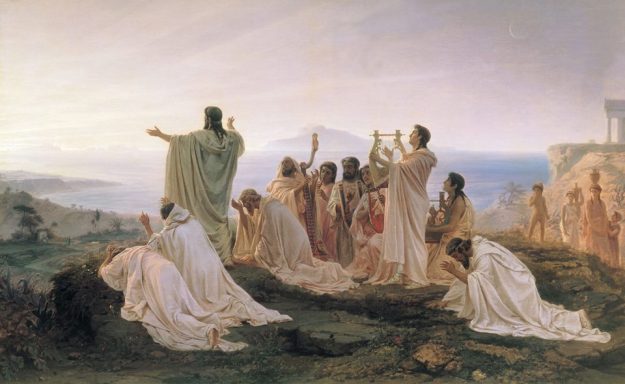
Pythagoreans

Pythagoreans celebrate sunrise by Fyodor Bronnikov

Every year at Christmas, I think about the ancient traditions that usher in the winter season. These folk beliefs form the foundation of how we celebrate the holidays in modern times. Why do we bring an evergreen tree into our livingrooms? Who is St. Nicholas? Why is Christmas red and green?

If you take a step back, keep an open mind and do some research, it’s easy to see that many of these traditions are symbols for winter survival. An evergreen tree stays green despite being blanketed by snow. The Christmas lights we hang are a representation of the fire of life going strong through the winter darkness. The gathering together of family to feast and exchange gifts comes from our interdependent, tribal origins. And the celebration of the birth of Jesus comes from the Winter Solstice.

December 21st is the longest night and the shortest day of the year. It is brought about by the turning of the Earth and happens every year without fail, just as the Sun rises and sets everyday.  At the Winter Solstice, the Sun is “reborn” for the coming year and the days literally become longer. The light increases. Not surprising that Jesus’s birthday is celebrated near the solstice, because it is synonymous with the birth of light.

There is no solid evidence that Jesus ever existed on earth, but the story of his life mirrors many ancient myths from cultures all over the world. It is the story of the sacrificed King, who’s death brings about the bounty of crops and the survival of the people.

From the “Women’s Encyclopedia of Myths and Secrets” by Barbara Walker: “It seems Jesus was not one person but a composite of many… He was eaten in the form of bread as were Adonis, Osiris, Dionysus and others… Like Attis, Jesus was sacrificed at the Spring Equinox and rose again from the dead on the third day, when he became God and ascended to heaven. Like Orpheus and Heracles, he ‘harrowed hell’ and brought a secret of eternal life, promising to draw all men with him up to glory (John 12:32). Like Mithra and all the other solar gods, he celebrated a birthday nine months later at the Winter Solstice… ”

It’s more than interesting, it’s important. It’s vital to our sense of humanity – to be open to learning how our social structures developed. It’s more important than ever this Christmas to love our fellow man and respect his path. I hope all of you have a wonderful Christmas holiday. The article below is a bit of fun too 🙂

First Historical Record of the Real Jesus Describes Him as a ‘Magician’

jesus

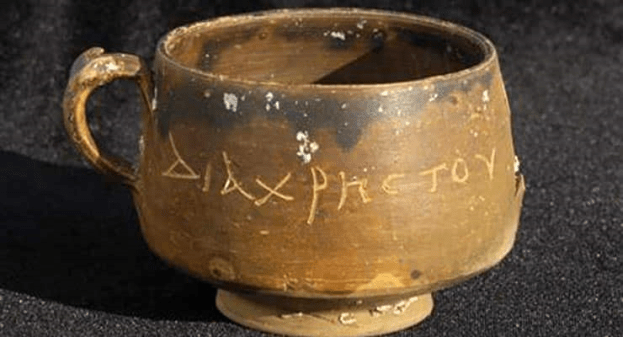
bowl from the late 2nd century B.C. which reads: “DIA CHRSTOU O GOISTAIS,” which has been interpreted to mean either, “by Christ the magician” or, “the magician by Christ.”

The artifact, dated to between the late 2nd century BC and the early 1st century AD was discovered by a team of scientists led by renowned French marine archaeologist Franck Goddio, during an excavation of the underwater ruins of Alexandria’s ancient great harbor.

The discovery could also provide evidence that the early Christians and Pagans shared many rituals and practices, and Christianity and paganism at times intertwined in the ancient world.


Via NBC News:

A team of scientists led by renowned French marine archaeologist Franck Goddio recently announced that they have found a bowl, dating to between the late 2nd century B.C. and the early 1st century A.D., that is engraved with what they believe could be the world’s first known reference to Christ.

If the word “Christ” refers to the Biblical Jesus Christ, as is speculated, then the discovery may provide evidence that Christianity and paganism at times intertwined in the ancient world.

Team leader Frank Goddio of the Oxford Center for Maritime Archaeology, said that “It could very well be a reference to Jesus Christ, in that he was once the primary exponent of white magic.”

The jury’s still out on whether the bowl is actually referring to the real Jesus Christ, but there’s no hiding the fact that even the prophet’s contemporaries compared his abilities to sorcery (Jesus was often accused of using demons to do his bidding).

Similar to the Jewish mystic Elijah (the undisputed patron of Lurianic Kabbalah and rider of fire chariots), the real Jesus was a wonder-worker who could freely go in and out of Super-Saiyan-mode. After his death, he was often linked with the Roman cult-hero Mithras and the magician Apollonius of Tyana, both pagan figures. Jesus’ “magical” side certainly wasn’t always unknown to modern thinkers. It was the 16th century philosopher Giordano Bruno who was one of the first to suggest that the real Jesus was just an extremely talented mage.

The engraving ‘could very well be a reference to Jesus Christ, in that he was once the primary exponent of white magic.’
Was Jesus Christ the magician? Times of Jesus Christ were imbued with magic and in the Hellenistic period of time, the lands around the Mediterranean have mixed different religions, traditions, philosophies and superstitions.

The Egyptians, Greeks, Romans and Jews were convinced that it is possible to possess the power of the gods, demons and spirits, and use it for your own purposes.

“The important thing was his power to do miracles,” writes Morton Smith in “Jesus, the Magician” and adds that “even the stories that seem to deny Jesus’ power to do miracles take for granted his reputation as a miracle worker…”

The ‘Book of Matthew’ refers to “wisemen,” or Magi, believed to have been prevalent in the ancient world. Egyptologist David Fabre, a member of the European Institute of Submarine Archaeology says the bowl is also very similar to one depicted in two early Egyptian earthenware statuettes depicting a soothsaying ritual.

“It has been known in Mesopotamia probably since the 3rd millennium B.C.,” Fabre said. “The soothsayer interprets the forms taken by the oil poured into a cup of water in an interpretation guided by manuals. The “magus” could have practiced fortune telling rituals using the bowl to legitimize his supernatural powers by invoking the name of Christ,” according to Goddio and Fabre.

“It is very probable that in Alexandria they were aware of the existence of Jesus” and of his associated legendary miracles, such as transforming water into wine, multiplying loaves of bread, conducting miraculous health cures, and the story of the resurrection itself,” according to Goddio.

The Bible reports that Jesus was accused of practicing magic, and the second century Roman philosopher Celus is quoted in the writings of the early Christian apologist Origen as saying that Jesus learned the arts of magic on Egypt, and then returned to his own country with these acquired skills.”