Happy Labor Day everyone! Good news, we are starting September off right with two planets resuming forward motion 🙂
Mars and Mercury are doing an odd dance right now. Mercury (in Retrograde) is barreling towards Mars (Direct) in the last degrees of Leo. Remember the eclipse a couple weeks ago?
The American eclipse on August 21st occurred at 28 degrees Leo. Mars will be ON that degree tomorrow, Saturday, Sept. 2nd! This transit inspires us to put our eclipse insights into motion and TAKE ACTION! We also have a Mars/Uranus trine (positive aspect) tomorrow! Expect the unexpected… revelations abound and the desire to be free and independent will reach a fever pitch.
Next week, Mars and Mercury will “cross” each other in the night sky causing a moving conjunction AT 29 degrees Leo. If that wasn’t enough (and it really is), Mercury is going Direct on Tuesday (Sept. 5th) at… you guessed it… 28 degrees Leo!!
Mercury (mind and communication) will be united with Mars (action and vitality) and you can finally move mountains in the right direction. Creativity, assertiveness and expression will be easy to access. This is an amazing event, and really beautiful. Astrology never ceases to amaze me.
Saturn turned Direct at 21 Sagittarius on Friday, August 25th at five in the morning. It’s the planet of responsibility, discipline and reality and can feel HEAVY. When Saturn is retrograde, things appear less stable in our personal lives and society at large. Thankfully we are now moving Direct, and issues will begin to get back on course. If you haven’t made progress on a project or goal, there’s steady movement now. Saturn in Sagittarius asks us to recommit to our Truth, Beliefs and Goals, and have discipline in our day to day activities.
The August 21st eclipse will be rolling out and affecting us for the next six months. Since it occurred in Leo, so we can look for a rebirth or change regarding our self expression, status, and identity. Art, clothes, music, leadership and public speaking are highlighted. Did you get any insights on your life?
Everyone will be impacted by August’s eclipse in different ways. If you’re interested in how it will affect you, set up a reading with me 🙂 I can give you a huge snapshot of your life story in a 15 minute phone reading.
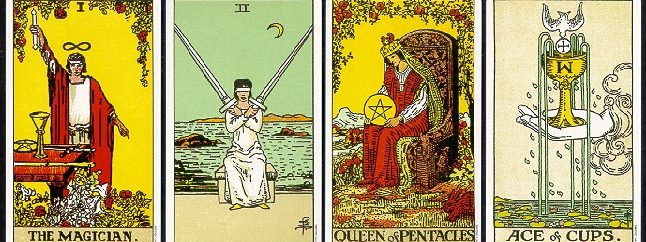
Excellent article and video on the tarot by Alejandro Jodorowsky.
“The practice of cartomancy, or divination with cards, dates back several hundred years to at least 14th century Europe, perhaps by way of Turkey. But the specific form we know of, the tarot, likely emerged in the 17th century, and the deck we’re all most familiar with—the Rider-Waite Tarot—didn’t appear until 1909. Popular mainly with occultists like Aleister Crowley and Madame Blavatsky in the early 20th century, the tarot exploded into popular culture in the new age 70s with books like Stuart Kaplan’s Tarot Cards for Fun and Fortune Telling, and by way of cult filmmakers like Alejandro Jodorowsky.
Since its relatively recent popularization, “fun” and “fortune telling” have more or less defined most people’s attitude to the tarot, whether they approve or disapprove of either one. But for artists and poets like William Butler Yeats, T.S. Eliot, and surrealist director Jodorowsky—whose film narration is perhaps the most poetic in modern cinema—the tarot has always meant something much more mysterious and inspiring. “The tarot,” says Jodorowsky in the short film above, “will teach you how to create a soul.”
After studying the Major and Minor Arcana and the suits, and puzzling over the symbols on each card, Jodorowsky discovered that “all 78 cards could be joined in a mandala, in just one image.” Learning to see the deck thus, “You must not talk about the future. The future is a con. The tarot is a language that talks about the present. If you use it to see the future, you become a conman.” Like other mystical poets, Jodorowsky’s study of the tarot did not lead him to the supernatural but to the creative act.
And like many a poet before him, Jodorowsky explored the journey of the Fool in his 1973 film The Holy Mountain, a “dazzling, rambling, often incoherent satire,” writes Matt Zoller Seitz, that “unfurls like a hallucinogenic daydream.” Jodorowsky’s cinematic dream logic comes not only from his work as a “shamanic psychotherapist.” He also credits the tarot for his psychomagical realism. “For me,” says Jodorowsky in the video at the top, “the tarot was something more serious. It was a deep psychological search.” The result of that search—Jodorowsky’s singular and totally unforgettable body of work—speaks to us of the value of such an undertaking, whatever means one uses to get there.
Or as Jodorowsky says in one of his mystical pronouncements, “If you set your spirit to something, that phenomenon will happen.” If that sounds like magical thinking, that’s exactly what it is. Jodorowsky shows us how to read the tarot as he does, for psychological insight and creative inspiration, in the video above, addressed to a fan named John Bishop. Spanish speakers will have no trouble understanding his presentation, as he quickly slides almost fully into his native language through lack of confidence in his facility with English. (The video belongs to a series on Jodorowsky’s YouTube channel, most of them fully in Spanish without subtitles.) Selecting a translation on YouTube yields rather garbled results.”
Did anyone see this exhibition in NYC last year?? Here’s an excellent article by Allison Meier on Hyperallergenic.com:“Installation view of ‘Mystery and Benevolence: Masonic and Odd Fellows Folk Art from the Kendra and Allan Daniel Collection’ at the American Folk Art Museum (all photos by the author for Hyperallergic unless noted)
A strange visual language developed from the 18th to the 20th century behind the closed doors of American secret societies. It’s a languae made up of all-seeing eyes, ominous skulls, hourglasses, arrows, axes, and curious hands holding hearts. Each of these icons was deeply symbolic for the thousands of people — mostly men — who participated in rituals of borrowed meaning, where ancient Egypt, biblical Christianity, and some homegrown amusements like wooden goats on wheels met the rise of American folk art. The American Folk Art Museum’s (AFAM) Mystery and Benevolence: Masonic and Odd Fellows Folk Art from the Kendra and Allan Daniel Collectionexamines this often hidden history through its arcane artifacts.
Unidentified Man in Independent Order of Odd Fellows Regalia, Artist unidentified (United States, 1840–60), quarter-plate daguerreotype, 4 3/4 x 3 3/4 in (courtesy American Folk Art Museum) (click to enlarge)
Mystery and Benevolence was curated by Stacy C. Hollander, chief curator and director of exhibitions at AFAM, and Aimee E. Newell, director of collections at the Scottish Rite Masonic Museum and Library. It features over 200 objects recently donated to the museum by Kendra and Allan Daniel, who spent three decades buying up the once-secretive art. Installed in the museum, the objects are an exuberant display of the “golden age” of Masonic and Odd Fellows objects, when American decorative and folk art merged with the need for a sense of belonging in the new country.
“After becoming an independent nation in the 1780s, America was seeking to establish its own cultural identity; Freemasonry offered a source of images that resonated with the new nation’s values of equality and liberty,” Newell writes in the accompanying catalogue. “Freemasonry’s visual language and American style began to intersect almost as soon as victory over the British was declared, and continued to adapt as the nation grew and the fraternity evolved. ”
Much of the exhibition contextualizes this long-hidden art in the history of the societies, such as their charity work. The Odd Fellows, formed in 18th-century London, were organized as a benevolent group to support the sick, orphans, and those who died without money for a funeral. One of their mission statements is proclaimed in red and gold on a large wooden sign: “Bury the Dead.” There are also axes indicating how the Odd Fellows saw themselves as “pioneers in the pathway of life”; staffs topped with a heart in the hand were a reminder to be open to others.
Similarly, even the more ghoulish imagery had some meaning connected to charity, and selflessness. The skulls, hourglasses, and skeletons holding shields painted with the word “fidelity” were all reminders of mortality, and how one’s brief time on earth could be better dedicated to others. Reverend Aaron B. Grosh wrote in 1853’s The Odd Fellow’s Manual: “Only the good or evil of our lives will survive us on earth, to draw down on our memories the blessings of those we have aided, or the contempt and reproach of those we have injured.”
Installation view of ‘Mystery and Benevolence,’ including items related to funerary traditionsIndependent Order of Odd Fellows Archway for Ensenore Lodge No. 438, signed “W. C. Baptist” (Auburn, New York, 1919), paint and gold leaf on wood with metalInstallation view of ‘Mystery and Benevolence’
“The outward form of each symbol offers a different point of access, but in its context within the lexicon of the fraternity, deeper meanings are revealed to those for whom the symbols are signified,” Hollander writes in the catalogue. “In this, the art of fellowship is not dissimilar to the art of alchemy, its secret knowledge also protected by its practitioners.”
Independent Order of Odd Fellows Banner, Artist unidentified (United States, 1900–20), paint on canvas, with wood and metal, 88 1/2 x 71 in (courtesy American Folk Art Museum) (click to enlarge)
The Masons are the country’s oldest established fraternal order, with numerous lodges founded in the 18th century across the US. In one painting on view at AFAM, their most famous member, George Washington, stands proudly at a Masonic altar. The Odd Fellows soon followed and quickly gained an important membership of their own, as did other societies like the Knights Templar, Shriners, and Junior Order of United American Mechanics. All were mostly white, male, and protestant, albeit from across different economic classes.
The objects in Mystery and Benevolence are seductive with their strangeness and feel somehow accessible through the ordinariness of the materials. I remember visiting the Masonic Hall on 23rd Street in Manhattan, and the tour guide (a Mason) pointing out that all the grand architectural flourishes were fancy fakery. The Corinthian columns, the Renaissance murals, and the Gothic arches that adorned different meeting rooms were all plaster — beautifully painted, but mimicry of the exotic and ancient all the same.
Likewise, the objects in this exhibition are visually stunning, from a late 19th-century staff wrapped with a snake to a towering column topped with a globe. There are some truly masterful pieces, like an intricate marquetry table by James J. Crozier, yet for the most part, the artists remain unidentified and the closest an object gets to a precious material is in the application of some gold leaf on the edges.
These are rare artifacts of an occult culture, each a labor of love for their ritual purpose, not originally intended as art, but as a tool of connection through shared rites. The value of these pieces goes beyond their folk art status. They represent a clandestine history embedded within the story of the United States, where for decades a large percentage of its men would amble over to the local lodge after dark, have a drink (or several), don a scarlet robe, then ponder a skeletal memento mori — or take a ride on a wooden goat around the lodge room.
Hand staffs in ‘Mystery and Benevolence’Independent Order of Odd Fellows Axe for Newtown Lodge No. 4440 (United States, 1850–75); Independent Order of Odd Fellows skull and crossbones plaque (United States, 1875–1900), paint and gold leaf on woodWashington as a Freemason, Publisher unidentified (United States, late 19th century), oleograph on linen, 28 1/2 x 22 3/8 x 1 3/8 in (courtesy American Folk Art Museum, photo by José Andrés Ramírez)Pair of Cherubim, artist unidentified (United States, 1900–25), metal with traces of gold leaf. They likely were once on a replica of the Ark of the Covenant.Installation view of ‘Mystery and Benevolence’Odd Fellows axes in ‘Mystery and Benevolence’Independent Order of Odd Fellows Staff with Serpent, Artist unidentified (United States, 1875–1900), paint on wood, 53 x 5 x 4 3/4 in (courtesy American Folk Art Museum, photo by José Andrés Ramírez)Painting of a church and cemetery in ‘Mystery and Benevolence’Independent Order of Odd Fellows Carpet, Artist unidentified (United States,1875–1925), wool, 61 x 35 1/2 in (courtesy American Folk Art Museum, photo by José Andrés Ramírez)Installation view of ‘Mystery and Benevolence’Independent Order of Odd Fellows Tracing Board, Artist unidentified (United States, 1850–1900), oil on canvas, 33 1/4 x 39 1/2 x 2 1/8 in (courtesy American Folk Art Museum, photo by José Andrés Ramírez)”Installation view of ‘Mystery and Benevolence’
Venus and Uranus were in an exact conjunction at 27 Aries yesterday. This noteworthy event happens every 225 days, and brings a fresh perspective to our personal relationships. Breakthroughs are common – both good and bad – and can show up the week preceding and the week following the aspect. So yeah, this new week upon us could reveal surprises and changes that can be challenging (but illuminating in the long run). Change is in the air.
So, how was your weekend? Did any shifts or insights occur on Saturday? The area where 27 Aries resides in your personal chart is where you will feel the effects most powerfully.
I had a funny, related experience. On my way to an event I passed an easy chair and a television in the middle of a street. They look like they had been thrown there by a strong force (Aries). Venus rules comfort and pleasure (i.e. the chair) and Uranus rules electricity and television (i.e. the TV). I wish now I had taken a picture of it!
Trust yourself. Create the kind of self that you will be happy to live with all your life. Make the most of yourself by fanning the tiny, inner sparks of possibility into flames of achievement. – Golda Meir
Sun into Gemini: May 20th at 1:31pm.
New Moon in Gemini: Thursday, May 25th at 12:44pm.
Mercury is Direct in Taurus.
Saturn – Uranus trine at 26 degrees (Sagittarius and Aries respectively) TODAY.
Venus Direct in Aries. Mars Direct in Gemini.
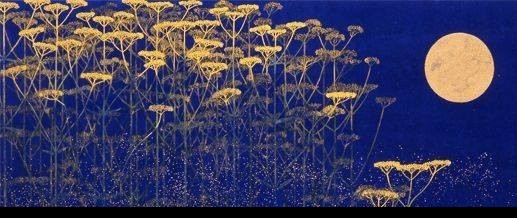
Silence of the Night, Reiji Hiramatsu
I’d say the big thing is this trine with Saturn and Uranus today. This is a harmonious connection between two complete opposites:
Saturn is reality, time, responsibility, history, discipline, commitment, stability, and the establishment. It is slow, solid change.
Uranus is revolution, invention, science, rebelliousness, genius, Change, disruption, electricity and awakening. It is sudden change.
So these two are having a friendly conversation today, which is interesting. If you have a duality in your life, you might find some common ground today. The main thing is that Saturn will INSIST on any changes you make being well thought out and solid. In my view, Saturn is heavier than Uranus and so those energies carry more weight, BUT they will have to find a compromise since Uranus will not be silenced.
A new physical reality comes into view.
A revolution with a solid foundation.
A path to making aspirations into realities.
This is a good day to set some goals ❤
This trine is also happening in the fire signs of Aries and Sagittarius, which brings guts, confidence, self esteem and passion. Creativity and adventure. Composers, artists, actors, musicians and performers are ignited by this energy today. Let your light shine.
Bob Marley inspired the lives of millions through his inspirational words and positive songs. Here are some of his most powerful words to live by.
1. “The greatness of a man is not in how much wealth he acquires, but in his integrity and his ability to affect those around him positively”
2. “Some people feel the rain. Others just get wet”
3. “Don’t gain the world and lose your soul, wisdom is better than silver or gold”
4. “Love the life you live. Live the life you love.”
5. “Beginnings are usually scary, and endings are usually sad, but its everything in between that makes it all worth living.”
6. “Live for yourself and you will live in vain; Live for others, and you will live again.”
7. “Don’t worry about a thing ’cause every little thing gonna be alright”
8. “If she’s amazing, she won’t be easy. If she’s easy, she won’t be amazing. If she’s worth it, you wont give up. If you give up, you’re not worthy.”
9. “You never know how strong you are until being strong is the only choice you have”
10. “The truth is everyone is going to hurt you. You just got to find the ones worth suffering for.”
“Even after his death Bob Marley lives on through his messages to the world. He believed in equality, love and music and we can all takes these beliefs into our own lives. The next time you’re having a bad day or simply need some motivation, remember these quotes. Share with someone you know to send positive vibes their way.”
” The common traits that people across all creative fields seemed to have in common were an openness to one’s inner life; a preference for complexity and ambiguity; an unusually high tolerance for disorder and disarray; the ability to extract order from chaos; independence; unconventionality; and a willingness to take risks.”
“What makes highly creative people different from the rest of us? In the 1960s, psychologist and creativity researcher Frank X. Barron set about finding out. Barron conducted a series of experiments on some of his generation’s most renowned thinkers in an attempt to isolate the unique spark of creative genius.
In a historic study, Barron invited a group of high-profile creators—including writers Truman Capote, William Carlos Williams, and Frank O’Connor, along with leading architects, scientists, entrepreneurs, and mathematicians—to spend several days living in a former frat house on the University of California at Berkeley campus. The participants spent time getting to know one another, being observed by researchers, and completing evaluations of their lives, work, and personalities, including tests that aimed to look for signs of mental illness and indicators of creative thinking.
Barron found that, contrary to conventional thought at the time, intelligence had only a modest role in creative thinking. IQ alone could not explain the creative spark.
Instead, the study showed that creativity is informed by a whole host of intellectual, emotional, motivational and moral characteristics. The common traits that people across all creative fields seemed to have in common were an openness to one’s inner life; a preference for complexity and ambiguity; an unusually high tolerance for disorder and disarray; the ability to extract order from chaos; independence; unconventionality; and a willingness to take risks.
Describing this hodgepodge of traits, Barron wrote that the creative genius was “both more primitive and more cultured, more destructive and more constructive, occasionally crazier and yet adamantly saner, than the average person.”
This new way of thinking about creative genius gave rise to some fascinating—and perplexing—contradictions. In a subsequent study of creative writers, Barron and Donald MacKinnon found that the average writer was in the top 15% of the general population on all measures of psychopathology. But strangely enough, they also found that creative writers scored extremely high on all measures of psychological health.
Why? Well, it seemed that creative people were more introspective. This led to increased self-awareness, including a greater familiarity with the darker and more uncomfortable parts of themselves. It may be because they engage with the full spectrum of life—both the dark and the light—that writers score high on some of the characteristics that our society tends to associate with mental illness. Conversely, this same propensity can lead them to become more grounded and self-aware. In openly and boldly confronting themselves and the world, creative-minded people seemed to find an unusual synthesis between healthy and “pathological” behaviors.”
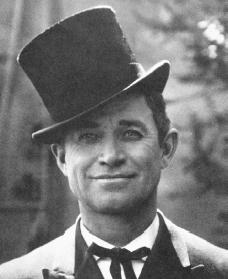
Will Rogers, who died in a 1935 plane crash, was one of the greatest political sages this country has ever known.
Here are some of his excellent quotes that still apply today:
1. Even if you’re on the right track, you’ll get run over if you just sit there.
2. Never slap a man who’s chewing tobacco.
3. Never kick a cow chip on a hot day.
4. Never miss a good chance to shut up.
5. Always drink upstream from the herd.
6. If you find yourself in a hole, stop digging.
7. The quickest way to double your money is to fold it and put it back into your pocket.
8. There are three kinds of men:
The ones that learn by reading.
The few who learn by observation.
The rest of them have to pee on the electric fence and find out for themselves.
9. Good judgment comes from experience, and a lot of that comes from bad judgment.
10. If you’re riding’ ahead of the herd, take a look back every now and then to make sure it’s still there.
11. Lettin’ the “cat outta the bag” is a whole lot easier’n puttin’ it back in.
12. Everything is funny, as long as it’s happening to somebody else.
13. A remark generally hurts in proportion to its truth.
ABOUT GROWING OLDER….
First ~Eventually you will reach a point when you stop lying about your age and start bragging about it.
Second ~ The older we get, the fewer things seem worth waiting in line for.
Third ~ Some people try to turn back their odometers. Not me; I want people to know ‘why’ I look this way. I’ve traveled a long way, and some of the roads weren’t paved.
Fourth ~ When you are dissatisfied and would like to go back to youth, think of Algebra.
Fifth ~ You know you are getting old when everything either dries up or leaks.
Sixth ~ I don’t know how I got over the hill without getting to the top.
Seventh ~ One of the many things no one tells you about aging is that it’s such a nice change from being young.
Eighth ~ One must wait until evening to see how splendid the day has been.
Ninth ~ Being young is beautiful, but being old is comfortable.
Tenth ~ Long ago, when men cursed and beat the ground with sticks, it was called witchcraft. Today it’s called golf.
And, finally ~ If you don’t learn to laugh at trouble, you won’t have anything to laugh at when you’re old




 elizabeth rose psychic and tarot