Category Archives: Psychology

Your brain on MUSIC

This is Your Brain on Music!

“When researchers observed brain activity in people who were reading or doing math, they noticed that certain parts of the brain would light-up. Generally, with any given activity, the brain would utilize just one specific region — however, when the researchers introduced music, something amazing happened.

Not only did listening to music cause the brain to light up in multiple areas, but when subjects began to play music, practically every section of the brain went to work in an explosive jubilee of activity!

Find out more about this mind-blowing discovery in this video.”

Source: http://blog.theliteracysite.com/this-is-your-brain-on-music/


Pretending You’re Creative Will Make You More Creative

young artist moulding raw clay in art studio

young artist moulding raw clay in art studio


“Being more creative may be as easy as pretending you are. Creativity, that abstract muse, is increasingly thought of as essential not just to artistic pursuits but also to business success. Who doesn’t want to be more creative? Or, conversely, who wants to be more formulaic and rote?

Article: http://mentalfloss.com/article/76358/pretending-youre-creative-will-make-you-more-creative-study-says

A new study by researchers at the University of Maryland indicates that, much like how stereotypes about women being bad at math can lead to women performing worse on math tests, treating yourself like a stereotypical creative genius can lead to more creative thinking. In two different experiments detailed in PLOS ONE, the researchers primed more than 200 undergrads majoring in several different forms of art or science to imagine themselves as either a stereotypically creative professional (“an eccentric poet”) or a stereotypically stodgy one (“a rigid librarian”). The students then completed the Uses of Objects Task, a standard psychology test to measure creativity (as you might guess, you brainstorm various uses of objects). A control group completed the task without being primed to imagine themselves as having any specific characteristics or jobs.

The researchers found that the ability to think outside the box isn’t a static personality trait. It’s malleable, and influenced by stereotypes. Students who imagined themselves as eccentric poets were able to think of more (and more original) uses for objects like bricks than students in the control group. Students who imagined themselves as rigid librarians came up with significantly fewer creative uses than the control group. Not only did thinking of themselves as eccentric give students a creative boost, but thinking of themselves as rigid became an impediment to creativity.”

What a good excuse to declare yourself an artist and act super wacky.

[h/t Pacific Standard]

Being at Peace with the Pain of Others

Can you stay open to the pain of others? The Practice: Being at peace with the pain of others. Why? Humans are an empathic, compassionate, and loving

Source: Being at Peace with the Pain of Others

Excellent article! Keeping a warm heart and doing what you can to help the person is great advice.

See the big picture
Whatever the pain of another person happens to be – perhaps due to illness, family quarrel, poverty, aging, depression, stressful job, worry about a child, disappointment in love, or the devastation of war – it is made up of many parts (emotions, sensations, thoughts, etc.) that are the result of a vast web of causes.

When you recognize this truth, it is strangely calming. You still care about the other person and you do what you can, but you see that this pain and its causes are a tiny part of a larger and mostly impersonal whole.

This recognition of the whole – the whole of one person’s life, of the past emerging into the present, of the natural world, of physical reality altogether – tends to settle down the neural networks in the top middle of the brain that ruminate and agitate. It also tends to activate and strengthen neural networks on the sides of the brain that support spacious mindfulness, staying in the present, taking life less personally – and a growing sense of peace.”

Research Says Talking To Yourself Improves Your Brain

Since we’re on the eve of a Full Moon in Virgo, check out this article from Higher Perspective.

277c5fd157af18edb997e816d21eb488“You’ve probably seen someone talking to themselves and thought they were really weird, right? Well stop thinking it and start saying it to yourself, because people who talk to themselves are actually pretty brilliant. Why?

They organize their thoughts better.

That’s right. Those who talk to themselves are better at organizing their thoughts and processing more than one thought at a time. They focus on saying their thoughts aloud in the hopes they can get a better grip on them. They actually have greater mental clarity as a result.

They have a better memory.

People who say things out loud to themselves are likely able to memorize and recall things better than those who don’t. It’s a way of reinforcing a thought inside of your brain.

Their brains are more efficient.

Some studies have indicated that talking to yourself helps you think quickly and with clarity. They found that when people talk to themselves at the store, they find what they need quicker than those who didn’t.

They achieve their goals.

People who talk to themselves, particularly about their goals, are more likely to achieve them than those who don’t. Saying it out loud helps create a laser-like focus on your goals and gets you closer to them.”

Here’s another great article from Elite Daily last year: http://elitedaily.com/life/culture/people-talk-to-themselves/1105688/


Low B12 Seen in Aging, Autism and Schizophrenia

2013-09-19-5-things-you-need-to-know-about-b12-deficiency-foods

The beauty of being alone

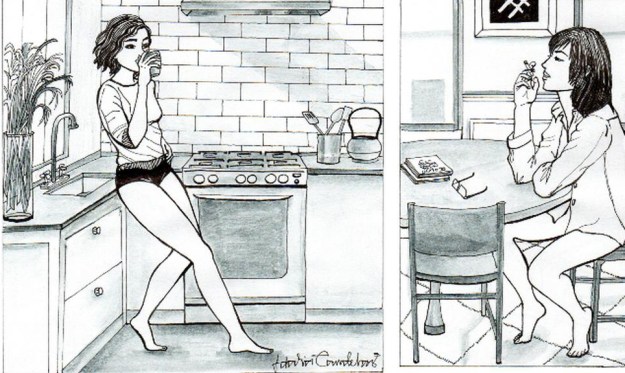
“I like to show women who exist in solitude but do not suffer,” Candelas said. “They are not depressed or crying. Rather [they] are safe, exalting in the sense of enjoying the company of just herself.”

“Of course, that’s not what we generally assume. Being alone often has a sad stigma attached to it, with some researchers going so far as to say too much alone time could actually be deadly (because some researchers are drama queens) because humans need a certain amount of social interaction. Yet plenty of people swear by how much pleasure doing things alone can bring, with some research suggesting it could actually be good for us.”

candelas

by Mexico-based artist Idalia Candelas


These Drawings Perfectly Demonstrate the Beauty of Single Life, Just in Time for V-Day

By Nicolas DiDomizio February 04, 2016

David Bowie’s “Lazarus” Video Isn’t Just a Goodbye, It’s a Harrowing Warning

1-doyt64E2UGjOTHluUBmFFw

“Do not waste any more time not expressing yourself.”

Excellent post by Jason Evangelho

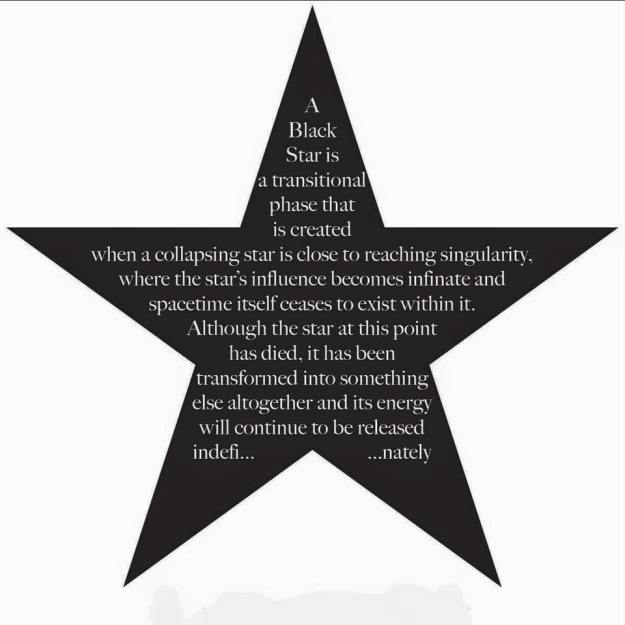
David Bowie’s ‘Lazarus’ Video Isn’t Just A Goodbye, It’s A Harrowing Warning

“It’s staggering how differently a piece of art can be interpreted both before and after someone’s death. In the case of the late David Bowie’s music video for “Lazarus,” what may have been viewed as an innocuous 4 minutes of trippy entertainment turns into a disturbing, emotionally raw, premeditated goodbye letter.

I appreciate the impact “Lazarus” — and by extension the entirety of Bowie’s final album Blackstar — has and will have on his fans. We now understand that it was always meant as a final gift from Bowie to his fans.

But for me, that video is a warning.

There’s a scene about 3 minutes into the “Lazarus” video that’s difficult to watch. Scratch that, the entire video is difficult to watch now. Let’s call this scene harrowing. Bowie sits at a desk, frustrated and seemingly impatient to find the right words to jot down in the notebook in front of him. Suddenly a brief smile lights up his face and he begins enthusiastically scrawling on the pad in front of him.

A few seconds later, it’s as if Bowie is overwhelmed. He’s frantically writing now, face wrinkled in concentration, writing so furiously that his hand spills off the page and down the front of his desk.

To me, it’s screaming that Bowie had so much left to say. To contribute. To create. But time has run out.

There’s sage advice embedded here, a thinly veiled warning: Do not waste any more time not expressing yourself. Say what you need to say, boldly and without reservation. Nurture your creativity and don’t be shy about it. Stop constantly consuming and start creating before it’s too late, and that dark, mysterious wardrobe into nothingness consumes you.

Leave your mark. Start today.”

12553071_10153244881540474_8903131831236776501_n

Five Ways Carl Jung Led Us to the “Inner Life”


Screen-Shot-2015-12-16-at-7.43.30-PM

Five Ways Carl Jung Led Us to the “Inner Life”

by Gary S. Bobroff

Lying behind much of the way we talk about the inner life today is the work of the Swiss psychologist C. G. Jung. He revolutionized how we discuss dreams and archetypes and gave us our words “introvert,” “extravert” and “synchronicity.” However, what made him a true psychological pioneer was that he looked inside himself in a way that is still unique today.

#1) Dreams

From earliest beginnings of human civilization, we have considered dreams a doorway to the soul. Jung saw that they showed us parts of ourselves that were being rejected by our waking consciousness: strengths unexpressed and shadow figures run amok; qualities that we were missing about ourselves; and desires that we’d rather not acknowledge. The mission of dreams was to balance us, to compensate for our often one-sided attitude toward life and lead us to integrate what we need for health and growth. We know today that dreams can have messages for us that are not only psychologically relevant, but even biologically urgent, relaying information about illness. Jung introduced the term “wholeness” to describe the aim of the unconscious: the further filling out of ourselves; an increasing completeness in the unique being that we are.

#2) Personality Types

Jung saw the differing pathways in our personalities. He observed that some people got energy from interacting with people, while others were drained by it. Introvert or extravert, intuitive or sensate, thinking or feeling; he described these differing forms as Psychological Types and they led to today’s MBTI categories. In normalizing different kinds of personality, Jung helped us to get over our natural biases against other types.

While he recognized variety in human personality, Jung believed that there was no one-size-fits-all approach to therapy. He saw each individual as having a unique blueprint for growth, an untold inner story, and he knew – from his own experience – that one man’s medicine is another’s poison.

 “The shoe that fits one person pinches another; there is no recipe for living that suits all cases.” – C. G. Jung

#3) Archetypes

Jung also saw that the unconscious sometimes conveys information beyond the personal. He saw that the dreams of his patients sometimes echoed mythological motifs from far-flung foreign cultures. He saw the action of peoples’ lives following forms depicted in Greek tragedy. He discovered ancient, even timeless, pathways that energy flowed into: toward some things and away from others, attracted to some things, repulsed by others. This level of the psyche is beyond the personal and Jung called it the collective unconscious.

“I thought of Jung as a noetic archeologist, [he] provided maps of the unconscious.” – Terence McKenna

The collective unconscious shows us eternal, dynamic qualities in our nature: they are alive and timeless. One of these archetypes is our inner opposite sex figure and soul guide–what Jung called the Anima or Animus. We encounter it both in our dreams and when just the right person walks up to us and we fall in love at first sight. Even though we experience this figure through others, but it is ultimately up to us to integrate it for ourselves.

Once we’ve learned to recognize these archetypes, we see them throughout classic literature and film and even in modern sitcoms. However, we may not really discover them for ourselves until we’ve been battered and bruised and are wondering how we got into this mess (again). Usually we need a little help to gain sight of these figures in our own lives.

“You don’t see something until you have the right metaphor to let you perceive it.” – Robert Stetson Shaw

#4) Synchronicity

Jung’s psychology is only really understood when it is a lived experience, and nothing exemplifies this more than the mystery of synchronicity. Jung coined the term synchronicity to refer to extraordinary moments when outer happenings reflect inner states. What we see in such a coincidence of events is a meaningful interplay alive in our reality. The notion that there’s a deeper principle actually operating in the world can be frightening to people from a culture that believes that it’s the only conscious force in the universe. Yet at the same time, discovering that there’s more going on can be experienced as a profound relief. In order to get through our resistance to such experiences, it helps to hear others’ stories and share our own (and you can do so here). Incorporating the meaning of these experiences for ourselves requires something authentic from us – a real inner change, the genuine achievement of a new attitude.

It is addressing life in the present that cleanses and heals a festering wound.  Jung never tired of saying this.  After the past is explored, additional inquiry into yesterday does not lead to further healing.  A change of attitude into the present does, and this change of attitude is exactly the business of a synchronicity.” – J. Gary Sparks, At The Heart of Matter

#5) Our Inner Life is Real

Tending to the unconscious, to dreams and to the inner voice are the acts that define Jungian psychology, but it’s not just the act that’s definitive, it’s the attitude. Jungian psychology recognizes that we’re more than just our ego and that there is more to the psyche than just the conscious mind. With this in mind, engagement with the inner voice is pursued not as a form of inner housekeeping, but rather in the humble service of the development of a relationship with an intelligence present within us but greater than our own. Committing to that service means relating more deeply to our inner nature; its only end-goal is the whole-bodied, whole-hearted, full blossoming of who we really are.

http://themindunleashed.org/2015/12/five-ways-carl-jung-led-us-to-the-inner-life.html
 

15 Things You Need To Know About People Who Have Concealed Anxiety

Interesting article about anxiety. I’ve never seen it this way but it makes a lot of sense!