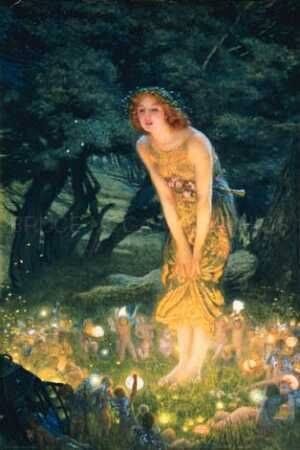
Summer Solstice. The high point of Light for the whole year! Longest day and shortest night. Leave a little saucer of milk and honey outside for the fairies under the light of the Full Moon.
Summer Solstice. The high point of Light for the whole year! Longest day and shortest night. Leave a little saucer of milk and honey outside for the fairies under the light of the Full Moon.

“The Path” by Reginald W. Machell
Full Moon in Sagittarius occurred at 4:02am Pacific today, and we all got a glimpse (or a big jolt) about our future path. The ruler of Sagittarius is the huge planet Jupiter – ruler of optimism, expansion, joviality, luck and money. This week it’s conjunct the North Node of the Moon which symbolizes The Future. Whenever the North Node is involved, our destiny appears. What insights did you receive today? What showed up in your life? This is your personal message about your path.
This Full Moon is intensified by Saturn in Sagittarius square to Neptune in Pisces. It was exact three days ago and impacts the energy of this moon. This is our dream meeting practical reality – and it can be painful. Saturn comes along, rips off our rose colored glasses and tests us on our personal beliefs. Saturn in Sagittarius is our truth and belief appearing as a wake up call. We are each starting a new phase in our lives.

Excellent post from Mystic Medusa:
“So he was a Solar Capricorn and that Sun in Capricorn strengthened by being part of a Grand Earth Trine – Sun in Capricorn trine Uranus in Taurus trine Neptune in Virgo. Big Earth Vibe like this often manifests as physical prowess, fantastic feats of athleticism and material grounding.
But see also the Leo Rising and the chutzpah it took to come out with some of his more brazen maxims. “I am the greatest – i said that before i even knew that I was.”
See also the Moon, Mercury and Venus in Aquarius. Moon-Mercury in Aquarius is activist by instinct – dissent is second nature to the psyche albeit in contrast to the more security, hierarchy-appreciating Earth energy. Venus is Retro and square Saturn, suggesting challenges in relationships with (Venus) women.
Mars and Saturn aligned with the Midheaven is a classic indicator of an enduring fame or ‘brand’ if you like.
The mid-60s era when he changed his name – dropping his “slave name” – and religion before becoming a conscientious objector against the Vietnam War was as Pluto and Uranus were crossing over his North Node.”
Source: https://mysticmedusa.com/2016/06/astrology-lesson-via-muhammad-ali/


New Moon today at 14 Gemini, 8:00pm Pacific.
Get ready for a talkative weekend. Socializing, public speaking, problem solving are all highlighted. The place where Gemini appears in your chart is where you are a genius! So get out there, be creative and express yourself.
Venus (beauty, love) is conjunct this New Moon, enhancing the socializing vibe and giving us an open window to exchange ideas with our mates. We can share our thoughts without risk of it erupting into emotional fireworks, but Saturn in opposition can bring some weight to the conversation.
This New Moon is part of a Grand Cross in the mutable signs:
14 Gemini: Sun, Moon and Venus
12 Pisces: Neptune
13 Sagittarius: Saturn
14 Virgo: Jupiter (with the North Node nearby)
Yes a Grand Cross indicates tension – but only as a platform to new growth. Saturn is the only tough planet involved here, and he just wants us to make decisions based in reality. Nothing wrong with that! Romance and love are absolutely highlighted now and for the next couple of weeks. Mostly, it’s a great time to meet new people and embody the Gemini social butterfly.
EXCELLENT article about partnership from the New York Times.

“IT’S one of the things we are most afraid might happen to us. We go to great lengths to avoid it. And yet we do it all the same: We marry the wrong person.
Partly, it’s because we have a bewildering array of problems that emerge when we try to get close to others. We seem normal only to those who don’t know us very well. In a wiser, more self-aware society than our own, a standard question on any early dinner date would be: “And how are you crazy?”
Perhaps we have a latent tendency to get furious when someone disagrees with us or can relax only when we are working; perhaps we’re tricky about intimacy after sex or clam up in response to humiliation. Nobody’s perfect. The problem is that before marriage, we rarely delve into our complexities. Whenever casual relationships threaten to reveal our flaws, we blame our partners and call it a day. As for our friends, they don’t care enough to do the hard work of enlightening us. One of the privileges of being on our own is therefore the sincere impression that we are really quite easy to live with.
Our partners are no more self-aware. Naturally, we make a stab at trying to understand them. We visit their families. We look at their photos, we meet their college friends. All this contributes to a sense that we’ve done our homework. We haven’t. Marriage ends up as a hopeful, generous, infinitely kind gamble taken by two people who don’t know yet who they are or who the other might be, binding themselves to a future they cannot conceive of and have carefully avoided investigating.
For most of recorded history, people married for logical sorts of reasons: because her parcel of land adjoined yours, his family had a flourishing business, her father was the magistrate in town, there was a castle to keep up, or both sets of parents subscribed to the same interpretation of a holy text. And from such reasonable marriages, there flowed loneliness, infidelity, abuse, hardness of heart and screams heard through the nursery doors. The marriage of reason was not, in hindsight, reasonable at all; it was often expedient, narrow-minded, snobbish and exploitative. That is why what has replaced it — the marriage of feeling — has largely been spared the need to account for itself.
What matters in the marriage of feeling is that two people are drawn to each other by an overwhelming instinct and know in their hearts that it is right. Indeed, the more imprudent a marriage appears (perhaps it’s been only six months since they met; one of them has no job or both are barely out of their teens), the safer it can feel. Recklessness is taken as a counterweight to all the errors of reason, that catalyst of misery, that accountant’s demand. The prestige of instinct is the traumatized reaction against too many centuries of unreasonable reason.
But though we believe ourselves to be seeking happiness in marriage, it isn’t that simple. What we really seek is familiarity — which may well complicate any plans we might have had for happiness. We are looking to recreate, within our adult relationships, the feelings we knew so well in childhood. The love most of us will have tasted early on was often confused with other, more destructive dynamics: feelings of wanting to help an adult who was out of control, of being deprived of a parent’s warmth or scared of his anger, of not feeling secure enough to communicate our wishes. How logical, then, that we should as grown-ups find ourselves rejecting certain candidates for marriage not because they are wrong but because they are too right — too balanced, mature, understanding and reliable — given that in our hearts, such rightness feels foreign. We marry the wrong people because we don’t associate being loved with feeling happy.
We make mistakes, too, because we are so lonely. No one can be in an optimal frame of mind to choose a partner when remaining single feels unbearable. We have to be wholly at peace with the prospect of many years of solitude in order to be appropriately picky; otherwise, we risk loving no longer being single rather more than we love the partner who spared us that fate.
Finally, we marry to make a nice feeling permanent. We imagine that marriage will help us to bottle the joy we felt when the thought of proposing first came to us: Perhaps we were in Venice, on the lagoon, in a motorboat, with the evening sun throwing glitter across the sea, chatting about aspects of our souls no one ever seemed to have grasped before, with the prospect of dinner in a risotto place a little later. We married to make such sensations permanent but failed to see that there was no solid connection between these feelings and the institution of marriage.
Indeed, marriage tends decisively to move us onto another, very different and more administrative plane, which perhaps unfolds in a suburban house, with a long commute and maddening children who kill the passion from which they emerged. The only ingredient in common is the partner. And that might have been the wrong ingredient to bottle.
The good news is that it doesn’t matter if we find we have married the wrong person.
We mustn’t abandon him or her, only the founding Romantic idea upon which the Western understanding of marriage has been based the last 250 years: that a perfect being exists who can meet all our needs and satisfy our every yearning.
WE need to swap the Romantic view for a tragic (and at points comedic) awareness that every human will frustrate, anger, annoy, madden and disappoint us — and we will (without any malice) do the same to them. There can be no end to our sense of emptiness and incompleteness. But none of this is unusual or grounds for divorce. Choosing whom to commit ourselves to is merely a case of identifying which particular variety of suffering we would most like to sacrifice ourselves for.
This philosophy of pessimism offers a solution to a lot of distress and agitation around marriage. It might sound odd, but pessimism relieves the excessive imaginative pressure that our romantic culture places upon marriage. The failure of one particular partner to save us from our grief and melancholy is not an argument against that person and no sign that a union deserves to fail or be upgraded.
The person who is best suited to us is not the person who shares our every taste (he or she doesn’t exist), but the person who can negotiate differences in taste intelligently — the person who is good at disagreement. Rather than some notional idea of perfect complementarity, it is the capacity to tolerate differences with generosity that is the true marker of the “not overly wrong” person. Compatibility is an achievement of love; it must not be its precondition.
Romanticism has been unhelpful to us; it is a harsh philosophy. It has made a lot of what we go through in marriage seem exceptional and appalling. We end up lonely and convinced that our union, with its imperfections, is not “normal.” We should learn to accommodate ourselves to “wrongness,” striving always to adopt a more forgiving, humorous and kindly perspective on its multiple examples in ourselves and in our partners.
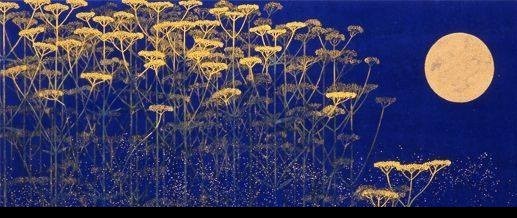
Silence of the Night, Reiji Hiramatsu
In this season of Gemini birthdays, it’s good to keep an eye on our thoughts. Gemini, ruled by Mercury, symbolizes the Mind, so while the Sun is in Gemini take stock of your thinking patterns and be present with them. Always try and keep your focus on the positive and what’s working in your life! This article shows it has a physical effect on your body:
“The words you choose to use can literally change your brain.
Dr. Andrew Newberg, a neuroscientist at Thomas Jefferson University, and Mark Robert Waldman, a communications expert, collaborated on the book, “Words Can Change Your Brain.” In it, they write, “a single word has the power to influence the expression of genes that regulate physical and emotional stress.”
When we use words filled with positivity, like “love” and “peace”, we can alter how our brain functions by increasing cognitive reasoning and strengthening areas in our frontal lobes. Using positive words more often than negative ones can kick-start the motivational centers of the brain, propelling them into action.
On the opposite end of the spectrum, when we use negative words, we are preventing certain neuro-chemicals from being produced which contribute to stress management. Each and every one of us are initially hardwired to worry; it’s how our primal brain protects us from dangerous situations for survival.
So, when we allow negative words and concepts into our thoughts, we are increasing the activity in our brain’s fear center (the amygdala), and causing stress-producing hormones to flood our system. These hormones and neurotransmitters interrupt the logic and reasoning processes in the brain and inhibit normal functionality. Newberg and Waldman write, “Angry words send alarm messages through the brain, and they partially shut down the logic-and-reasoning centers located in the frontal lobes.”

An excerpt from their book tells us how using the *right* words can literally change our reality:
“By holding a positive and optimistic [word] in your mind, you stimulate frontal lobe activity. This area includes specific language centers that connect directly to the motor cortex responsible for moving you into action. And as our research has shown, the longer you concentrate on positive words, the more you begin to affect other areas of the brain.
Functions in the parietal lobe start to change, which changes your perception of yourself and the people you interact with. A positive view of yourself will bias you toward seeing the good in others, whereas a negative self-image will include you toward suspicion and doubt. Over time the structure of your thalamus will also change in response to your conscious words, thoughts, and feelings, and we believe that the thalamic changes affect the way in which you perceive reality.”
A study done by Positive Psychology further elaborates on the effects of using positive words. A group of adults aged 35-54 were given a nightly task of writing down three things that went well for them that day, including an explanation of why. The following three months showed their degrees of happiness continued to rise, and their feelings of depression continued to decline. By focusing and reflecting on positive ideas and emotions, we can improve our overall well-being and increase functionality of our brain.
What words do you choose to focus your energy on? If you notice your life isn’t exactly “peachy,” try carrying a journal with you to keep track of how often you use negative words. You may be surprised to find how simple the solution to a better life really is- change your words, change your life.”
http://www.everydayhealth.com/columns/therese-borchard-sanity-break/420/
How Do Words, such as Yes and No, Change Our Brains and Lives?

Full Moon in Sagittarius, May 21st, 2016, 2:14pm Pacific.
This Full Moon is conjunct Mars Retrograde in Sagittarius. Ordinarily this brings impatience and temper tantrums, but Sag’s ruler Jupiter is currently in Virgo – giving us some restraint, maturity and focus on self care.
Sagittarius is the sign of the Centaur, Archer, Wild Horse and Wounded Healer. What are you aiming at? This full moon is about reviewing the goals you set for yourself at the Spring Equinox, March 21st. Or write some goals down on paper. It’s good to maintain focus with all the wild energy flying around this year. I bet the Preakness will be an exciting race on Saturday! Horse energy rules.
The Sun entered Gemini today at 7:36am Pacific. Gemini is ruled by the planet Mercury, which is currently motionless in the skies above us; preparing to turn Direct on Sunday the 22nd at 6:20am. Stay away from making big commitments or purchases – wait for next week when Mercury is moving forward again. The month of May has been slow moving with Mercury and Mars retrograding together. We’ve had to retrace our steps to be certain our dreams have a solid foundation. This will start turning around now!
May 20th Sun enters Gemini
May 21st Full Moon 1 Sagittarius
May 22nd Mercury Direct at 14 Taurus, Sun conjunct Mars
May 24th Venus enters Gemini
May 26th Jupiter square Saturn
May 27th Retro Mars enters Scorpio

It’s a VERY witchy night tonight. April 30th is a huge traditional celebration in many cultures throughout the world. It occurs six months from Halloween, and has the same flavor – but with a view of celebrating Spring.
Halloween is when the veil between our world and the spirit world is at it’s thinnest and it’s easy to see the returning spirits of the Mighty Dead. On Walpurgis Night the world’s are farthest apart.
Most cultures mark these ancient farming celebrations with fire, sex and odes to nature. Spring is about fertility – for ourselves, our animals and our fields. I view Walpurgis Night and Halloween as times to mark the ecstatic energy of life. That we are all here on this planet as part of it, and in tune with it. Celebrate. Face your fears and jump a fire.
The wildest, witchiest celebrations are in Germany (from what I’ve been told) and I would LOVE to see it someday. If you have any further information or images please share them in the comments below! Happy May Eve!
Here’s more info: https://en.wikipedia.org/wiki/Walpurgis_Night

“Unless you’re an audio engineer, you’ll have little reason to know what the term “convolution reverb” means. But it’s a fascinating concept nonetheless. Technicians bring high-end microphones, speakers, and recording equipment to a particularly resonant space—a grain silo, for example, or famous concert hall. They capture what are called “impulse responses,” signals that contain the acoustic characteristics of the location. The technique produces a three dimensional audio imprint—enabling us to recreate what it would sound like to sing, play the piano or guitar, or stage an entire concert in that space. As Adrienne LaFrance writes in The Atlantic, “you can apply [impulse responses] to a recording captured in another space and make it sound as though that recording had taken place in the original building.”
 elizabeth rose psychic and tarot